;)
AI for social good: Wadhwani AI


This article is part of the ongoing AI for Social Good series, where we spotlight social enterprises harnessing artificial intelligence to drive meaningful change. From education to healthcare, each story in this series explores how purpose-driven organisations are navigating the opportunities and challenges of AI adoption in the real world. You can now also read a story of M-Shule, Kabakoo, Rainforest Connection’s Guardian, Masakhane and Social Enterprise Republic of Ireland and learn how they use AI to serve their communities.
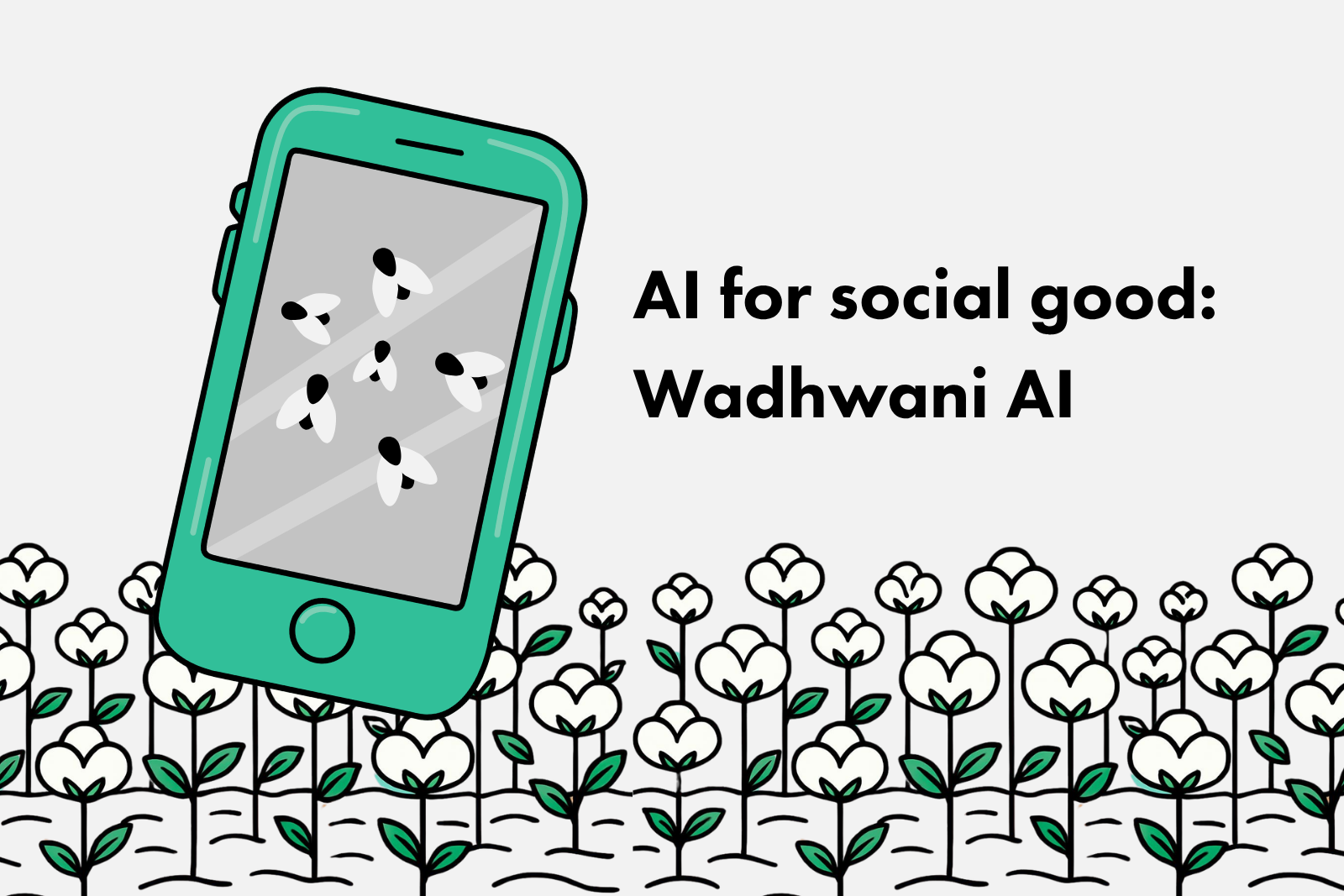
Wadhwani AI India’s CottonAce is an AI-powered pest management solution designed for smallholder cotton farmers, particularly in India, where cotton sustains nearly 100 million livelihoods. By enabling early detection and data-driven pest control, CottonAce reduces crop losses, pesticide misuse and farmer indebtedness. The app uses smartphone images of pheromone traps to identify and count pests, generating instant recommendations on whether to spray, which chemicals to use and when. Already deployed in nine languages and operable offline, CottonAce improves yields, increases farmer incomes and reduces pesticide costs by up to 25%. Supported by Google.org’s AI for the Global Goals grant, Wadhwani AI is now expanding this approach to protect staple crops like rice, wheat and corn, aligning with SDG2 (Zero Hunger) and SDG12 (Responsible Consumption and Production).
Background
Cotton farming is the primary livelihood for nearly 100 million farmers globally, with 90% of them small-scale producers cultivating less than an acre of land. India alone contributes 26% of the world’s cotton, employing over 5.8 million farmers and another 40–50 million people in processing and trade.
Yet cotton farming faces severe vulnerabilities:
- Pest pressure: Up to 30% of crops are lost annually due to pests, with bollworms responsible for 70% of the damage.
- Ineffective pesticide use: Despite consuming over 50% of India’s pesticides, misapplication is common, harming farmer health and ecosystems.
- Low productivity: Indian cotton yields average 487 kg/ha, far below the global average of 768 kg/ha.
Traditional pest monitoring methods, manual counts and delayed advisories are labour-intensive, error-prone and unscalable. This contributes to farmer indebtedness, economic instability and environmental degradation.
The AI Solution
CottonAce leverages computer vision and AI models to deliver real-time pest management advice:
- Pheromone traps and smartphone app: Farmers install traps, upload photos via the app and the algorithm validates image quality, identifies pests and counts them.
- Threshold-based recommendations: AI compares pest density against the Economic Threshold Limit (ETL) to recommend if and when spraying is necessary and with which chemical.
- Knowledge sharing: Pest data is shared with nearby farmers, creating a localised early warning system that functions even if they lack smartphones.
- Technical optimisation: Neural net pruning compresses the model to fit on basic smartphones, enabling offline, low-cost scalability.
Implementation and Partnership
Developed by Wadhwani AI, a non-profit applying AI to poverty reduction, CottonAce has scaled through partnerships with government and private sector actors. Key enablers include:
- Farmer networks: Lead farmers serve as local tech stewards for pest monitoring.
- Dashboards for extension officers: Track pest trends, geospatial infestation patterns and farmer participation.
- Google.org partnership: A $3.3 million AI for the Global Goals grant supports scaling to food crops and embedding into India’s Ministry of Agriculture digital systems.
Impact and Results
- Economic benefits: Farmers report 20% higher profits and a 25% reduction in pesticide costs using CottonAce recommendations.
- Agricultural resilience: Crop losses are mitigated by faster and targeted interventions and higher yields improve food and income security.
- Health and environment: Reduced pesticide misuse lowers risks to farmer health and minimises chemical pollution.
- Policy recognition: Integrated into government digital systems and cited as a model for AI-driven poverty alleviation.
Lessons and Next Steps
Key lessons:
- Accessibility is essential: Offline functionality and multilingual support make technology inclusive for rural farmers.
- AI must complement local knowledge: Lead farmers and community alerts enhance trust and uptake.
- Scalability requires partnerships: Embedding tools within government systems ensures long-term sustainability.
Next steps:
- Expand beyond cotton: Apply CottonAce’s AI models to staple crops (rice, wheat, corn) for national food security.
- Enhance inclusivity: Integrate with call centres and chatbots (e.g., PM Kisan) to reach farmers without smartphones.
- Sustainability focus: Further reduce environmental pesticide use while boosting climate resilience in agriculture.
References
https://www.wadhwaniai.org/programs/pest-management/ https://borgenproject.org/wadhwani-ai/
https://www.wadhwaniai.org/programs/pest-management/pest-management-ai-solution/