;)
AI for social good: Rainforest Connection’s Guardian


This article is part of the ongoing AI for Social Good series, where we spotlight social enterprises harnessing artificial intelligence to drive meaningful change. From education to healthcare, each story in this series explores how purpose-driven organisations are navigating the opportunities and challenges of AI adoption in the real world. You can now also read a story of M-Shule, Kabakoo, Wadhwani AI, Masakhane and Social Enterprise Republic of Ireland and learn how they use AI to serve their communities.
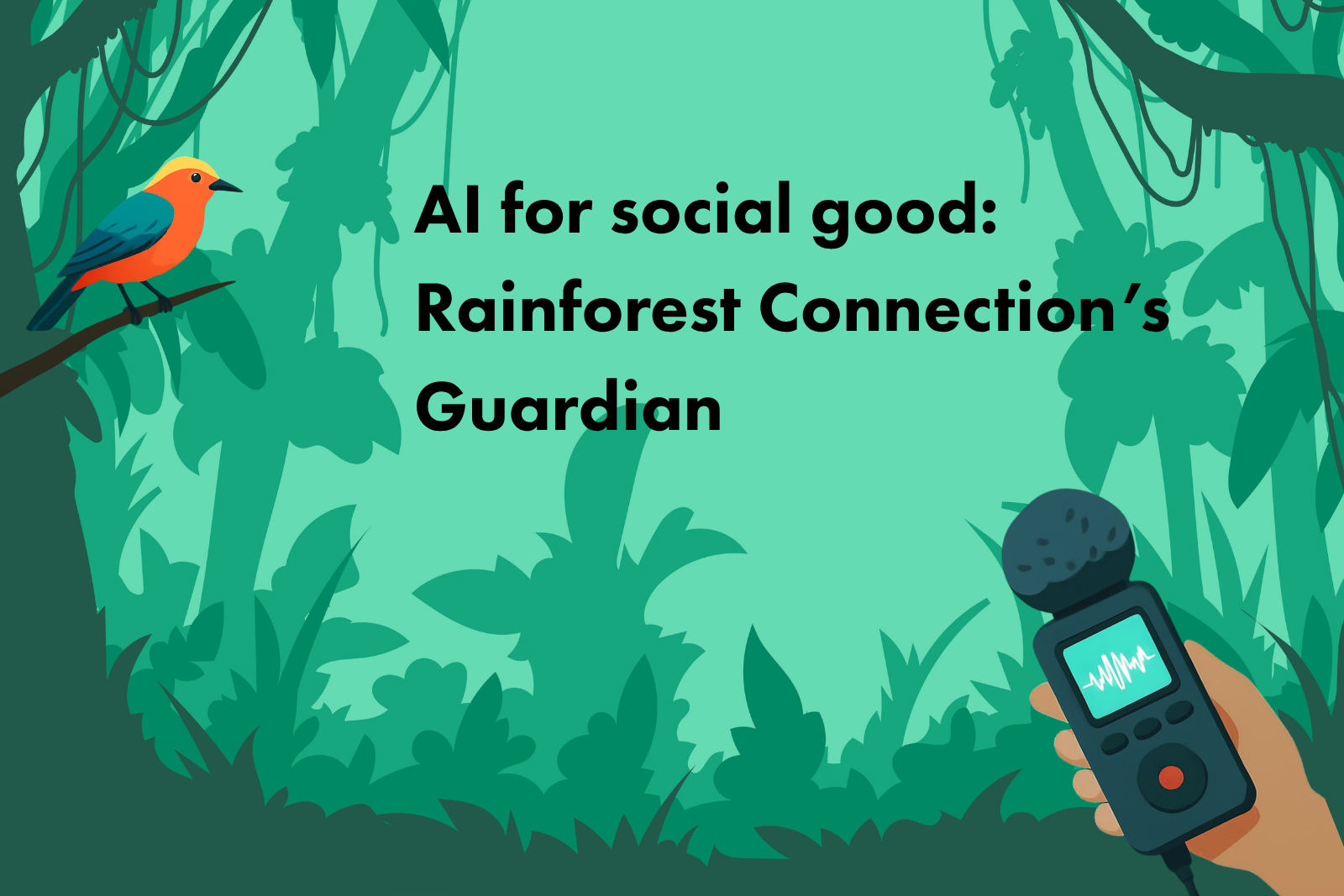
Rainforest Connection’s Guardian Platform is a solar-powered, AI-enabled acoustic monitoring system that detects illegal logging and poaching in real time. Guardian devices stream or locally analyse forest soundscapes (chainsaws, trucks, gunshots, species calls), then trigger instant alerts to rangers via GSM (Global System for Mobile Communications) or satellite.
Built to survive harsh rainforest conditions, Guardians operate autonomously and at scale. Today, there are 587 devices deployed across 37 countries, monitoring 736,200 hectares. The system has also catalogued over 160 million audio files. From this dataset, it has identified 4,208 species, including 408 that are threatened. In addition, 955 species can now be automatically recognised by the AI model.
The platform has earned global recognition, demonstrating how AI can protect biodiversity and forest carbon sinks through timely, data-driven enforcement.
Background
Illegal logging is among the world’s most significant transnational crimes (USD 50–150B annually), accelerating deforestation and undermining forests’ role as critical carbon stores. Conventional measures, such as patrols struggle with vast areas, delayed detection and limited connectivity. A durable, scalable and always-on sensing system was needed to detect threats as they occur, direct rangers efficiently and document ecosystem activity for conservation decisions.
The AI solution
The platform consists of three core components: solar-powered monitoring devices, connectivity systems that transmit data from remote locations and AI models that analyse sounds and generate alerts.
- Guardian device (treetop, solar-powered):
- High-sensitivity external microphone capturing ambient sound within 50–1,500 m.
- GSM/Wi-Fi for continuous streaming to the cloud; satellite mode for on-device audio analysis with real-time alerts.
- Built for the rainforest: IP66 enclosure, custom solar array (up to 30 W) tuned for canopy light, dual batteries (>50 Wh), custom power board, tamper-detect accelerometer, GPS, Bluetooth and a mounting frame/arm.
- High-sensitivity external microphone capturing ambient sound within 50–1,500 m.
- AI + Machine Learning (ML) analysis:
- Detects patterns associated with threats (e.g., chainsaws, trucks, gunshots).
- In satellite mode, it runs on-board models and transmits instant alerts with location to ranger apps.
- Continuous bioacoustic monitoring supports species detection and ecosystem research.
- Detects patterns associated with threats (e.g., chainsaws, trucks, gunshots).
Implementation and partnership
- Deployment at scale: 587 Guardians across 37 countries and 155 protected reserves, monitoring 736,200 hectares.
- Operations in extreme environments: Hardware designed for heat, humidity, pests and limited sunlight under dense canopy.
- Ecosystem partnerships and recognition: The “Nature Guardian” collaboration with Huawei won the GSMA 2021 GLOMO for Outstanding Mobile Contribution to the UN SDGs. Mobile operators and local partners provide connectivity and field support.
- Flexible connectivity: GSM for streaming + cloud AI; satellite (SWARM) for off-grid edge inference and alerting.
Impact and results
- Real-time protection: Alerts enable rapid ranger response to illegal logging and poaching indicators before damage escalates.
- Conservation footprint: Monitoring 736,200 hectares via 587 canopy nodes.
- Biodiversity insights:
- 160M audio files recorded.
- 4,208 species identified; 408 near-threatened to critically endangered.
- 955 species can be auto-detected in real time (and growing).
- 160M audio files recorded.
- Scalable model: Acoustic sensing covers wider ranges than vision and uses less bandwidth, making continuous monitoring feasible over vast areas.
Lessons and next steps
What works
- Edge + cloud hybrid is essential: satellite on-device inference ensures alerts even without GSM; cloud scales analytics and archives bioacoustic data.
- Design for the biome: Ruggedisation (IP66, custom solar, tamper sensing) is non-negotiable for uptime in tropical forests.
- Acoustics fit the problem: Sound carries far, needs less bandwidth and reliably captures human and wildlife activity.
What’s next
- Expand species and threat models: Grow beyond 955 auto-detected species and continually refine detection of illegal activities.
- Broaden ecosystems and use-cases: Continue extending from rainforests to mountains and oceans; support research (e.g., primates, foxes, cetaceans) alongside enforcement.
- Deeper integrations: Strengthen workflows with ranger teams, protected-area managers and telecom partners to accelerate response and long-term protection.
References
https://climatetechdigital.com/editorial/ai-powered-tech-is-tackling-illegal-logging-in-rainforests
https://www.huawei.com/en/news/2021/6/tech4all-nature-guardian-glomo
https://sustainabilitymag.com/articles/how-ai-is-protecting-trees-from-illegal-logging-in-real-time