

;)
AI in a national social enterprise network: The SERI story


This article is part of the ongoing AI for Social Good series, where we spotlight social enterprises harnessing artificial intelligence to drive meaningful change. From education to healthcare, each story in this series explores how purpose-driven organisations are navigating the opportunities and challenges of AI adoption in the real world. You can now also read a story of M-Shule, Kabakoo, Wadhwani AI, Rainforest Connection’s Guardian and Masakhane and learn how they use AI to serve their communities.
Social Enterprise Republic of Ireland (SERI) is a practitioner-led, member-based organisation with a vision to create a world-class environment for social enterprises to thrive in Ireland. Championing the sector both nationally and internationally, SERI represents and promotes the collective voice of its members, guided by core values of integrity, boldness, warmth and an entrepreneurial spirit.
The problem
In the Irish context, a typical social enterprise leader is likely a woman (69% of social enterprise leaders in Ireland are) running an organisation on under €100,000 a year. She’s the business leader, the programme manager, the grant writer, the governance lead and the board secretary. She’s not doing two jobs. She’s doing five. And she doesn’t have the resources to hire people to share the load.
This is the reality SERI was built to serve. And it is also similar to the reality of SERI itself. As a national representative body operating with fewer than two full-time staff, SERI aims to match the output of organisations with 20 or even 50 employees.
The question they set themselves was straightforward: could AI act as a genuine force multiplier – the sling in a ‘David versus Goliath’ contest – for a small team doing big work? And if it could work for them, could they teach the social enterprises they serve to do similar?
The approach
SERI was clear from the outset that they were not a technology organisation. Their CEO, John Logue’s, starting point was to address the human problem and decide what technology might help. Rather than building a technology strategy, they focused on identifying specific, named problems their members were struggling with and working backwards to the tools that could solve them.
To do that well, they needed technical expertise they didn’t have in-house. A voluntary Technology Advisory Council – drawing on the concentration of major tech companies headquartered in Ireland – helped them to create a roadmap and advised on how to hire an engineer in residence. They recruited a young engineer initially just two days a week, building their entire platform on a low-code/no-code stack: Softr for the platform, Make for automation and a combination of Claude and ChatGPT for AI functionality, split-tested for quality.
The total monthly technology cost: €471.
One early lesson came quickly. In the rush to get started, SERI found themselves relying on 10 or 11 third-party tools before rationalising their use. The problem was practical: getting to grips with two or three tools is manageable, 11 is overwhelming, especially for a small team already stretched for time. Their advice now: measure twice, cut once. Identifying the problem you’re trying to solve and building a strong underlying process should always come first, otherwise the tools will only add to the overwhelm.
The tools
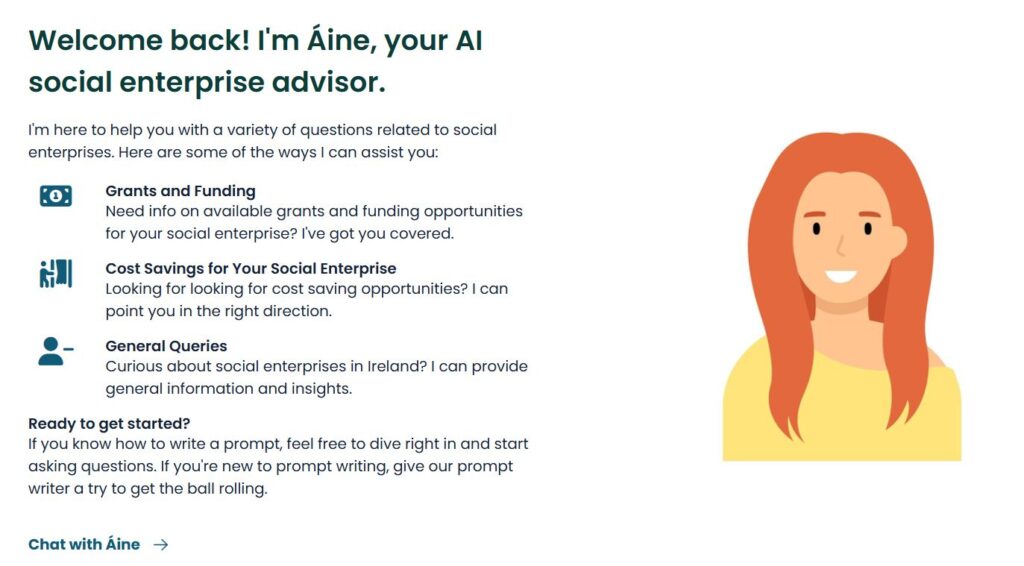 Áine (Advisor Bot) acts as an always-on mentor and librarian, trained on SERI’s own content – funding alerts, governance templates and training resources. Members ask questions in plain language and get relevant answers instantly, without manually searching through directories.
PeerX AI connects social entrepreneurs with each other. Members post a current barrier or challenge alongside their skills and experience. The AI scans the entire network to find the best possible match and generates an introduction email, which a human staff member reviews before sending, keeping a meaningful person in the loop.
Sphere AI tackles procurement – one of the most significant barriers facing social enterprises. The platform connects public and private buyers with social enterprise suppliers, with AI generating tailored Requests for Quote automatically. It focuses deliberately on below-threshold contracts, bypassing the formal procurement system where smaller enterprises are routinely overlooked.
The AI Social Enterprise Network runs monthly virtual sessions teaching members to use AI tools in their own workflows – building capability across the sector, not just dependency on SERI’s platforms.
GovLink (in development) will match a social enterprise’s work against live government policy priorities and suggest language for pitching directly to relevant departments for state funding.
Results
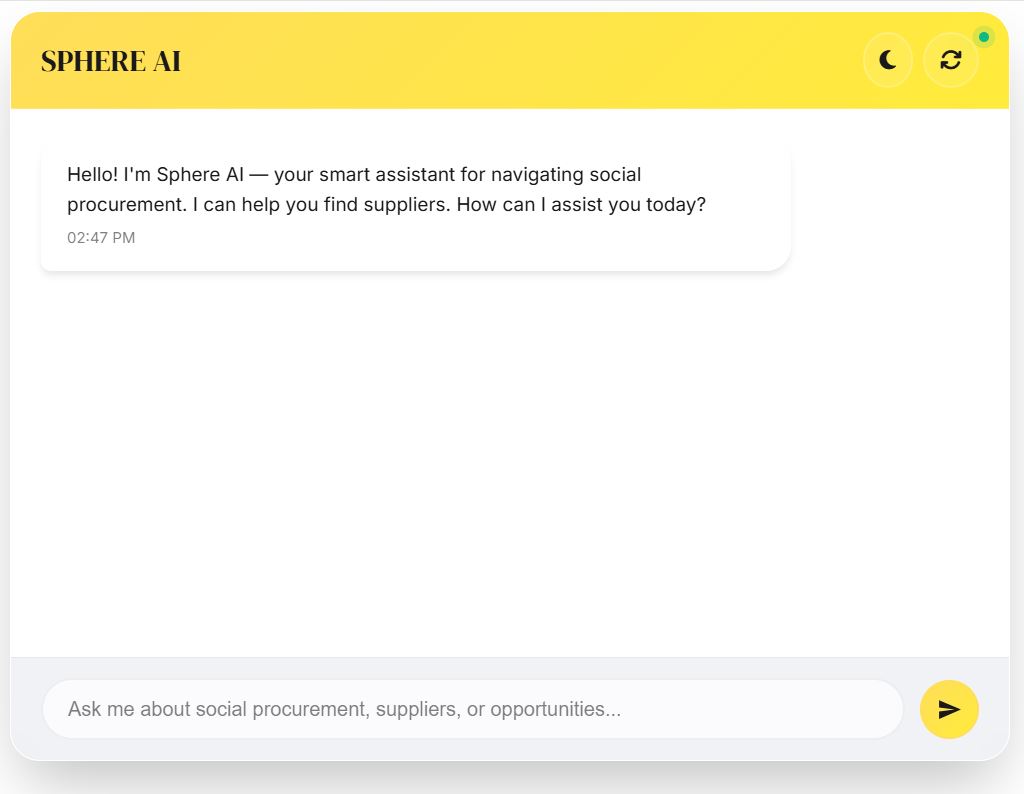 Now over a year into operation, SERI’s tools are producing tangible results across the network. With 650 social enterprises participating in the AI Social Enterprise Network and 58 buyers active on Sphere, the platform is still growing but the impact is already visible in practice:
- Automation of processes like volunteer application management can give back social enterprise staff 5-10% of their working week.
- Members are finding relevant funding and trading opportunities through Áine that they would not have identified through manual searching.
- PeerX AI is generating connections between social entrepreneurs that would not otherwise have happened, matching organisations facing similar challenges across the network.
- Reanalysing their annual member survey using an LLM (large language model) produced significantly richer insights than the team had been able to extract manually, informing decisions about the platform’s direction.
Lessons
Start by understanding what your members actually need. SERI’s highest-rated member feature in annual surveys is their WhatsApp community, scoring consistently 9 to 9.5 out of 10, higher than any AI tool they have built. Rather than viewing this as a surprise, they see it as a validation of their approach. Because they listened to their members from the outset, they knew to keep the WhatsApp community, rather than replacing it with something more sophisticated. The tool that scores highest isn’t the most technically impressive, but meets a real need.
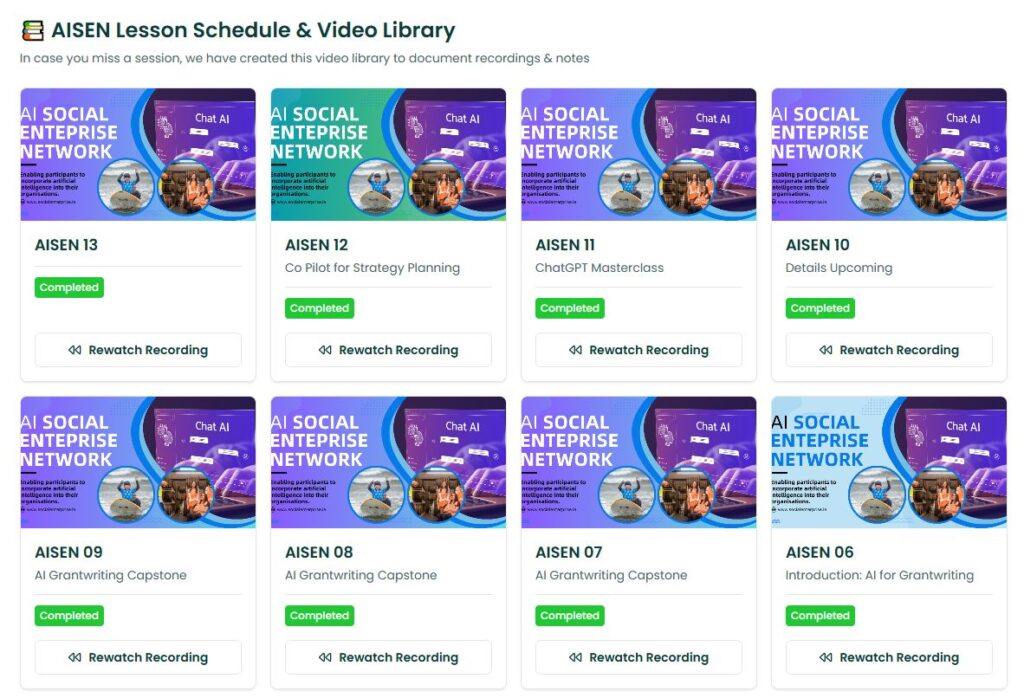 Building is only half the battle. SERI’s early assumption that a well-built tool would naturally attract users proved wrong. The reason comes down to the reality of their members’ lives. A social enterprise leader who attends an induction session steps out of what SERI describes as a fast moving river – the relentless daily pressure of running an under-resourced organisation. The moment they step back in, the training starts to fade. They’re not disengaged, they’re busy running their enterprises.
The solution was repetition and accessibility rather than more sophisticated technology. Loom video tutorials sit at the top of every page on the platform. Monthly onboarding sessions are open to new and existing members alike. Their regular member email carries tool reminders every time it goes out. The principle: “When you’re sick of talking about it and the newspapers are sick of writing about it, that’s when people are starting to hear your message.”
Advice for others
SERI is explicit that their model is designed to be replicable. For any social enterprise network considering a similar path, they offer three lessons drawn from their own experience:
Look beyond the corporate talent pool. Socially conscious developers – what SERI calls “vibe coders” – can be found in university incubators and national programmes, often prioritising meaningful work over salary.
Start small and part-time and don’t underestimate what that means. When SERI first asked their engineer how long a new tool would take to build, they expected months, while in fact they had a prototype ready that weekend. Their engineer’s role started from two days a week and has since grown to four as additional funding was secured. However, two days was still plenty to be genuinely impactful.
Prototype before you hire. Non-technical staff can spend a few focused hours each week using a premium LLM to interview themselves about their needs, building a detailed specification that can be fed into a low-code tool like Lovable to create working prototypes – before any technical hire is made. You don’t need to wait until you can afford the perfect team.
Staying accountable at the frontier
For social enterprises, AI is still largely uncharted territory. The ethical questions – around data use, algorithmic bias and the risk of technology widening rather than closing inequality – are real and largely unsettled. Add in the lack of resources to navigate those questions properly and it is understandable that many organisations are hesitant to move at all.
SERI are not afraid to be frontier explorers in that landscape – but they do it with their eyes open. A Technology Advisory Council comprising Chief Information Officers (CIOs) and software developers provides oversight on data protection, system bias and ethical use. They commit to transparency, data minimisation and one clear principle: “We are prepared to end this programme if we think we’re doing more harm than good.”
Case study produced as part of the SEWF AI for Social Good project.
Also read:
 Social enterprise news roundup – July 2026
  Euclid Network – the European Social Enterprise Network welcomes SEWF23 to Europe!
  Social enterprise news roundup – August 2026
  Social enterprise opportunities – September 2026
  From funding to income: How White Box Enterprises is supporting social enterprises to start and grow in Australia, while also generating revenue