;)
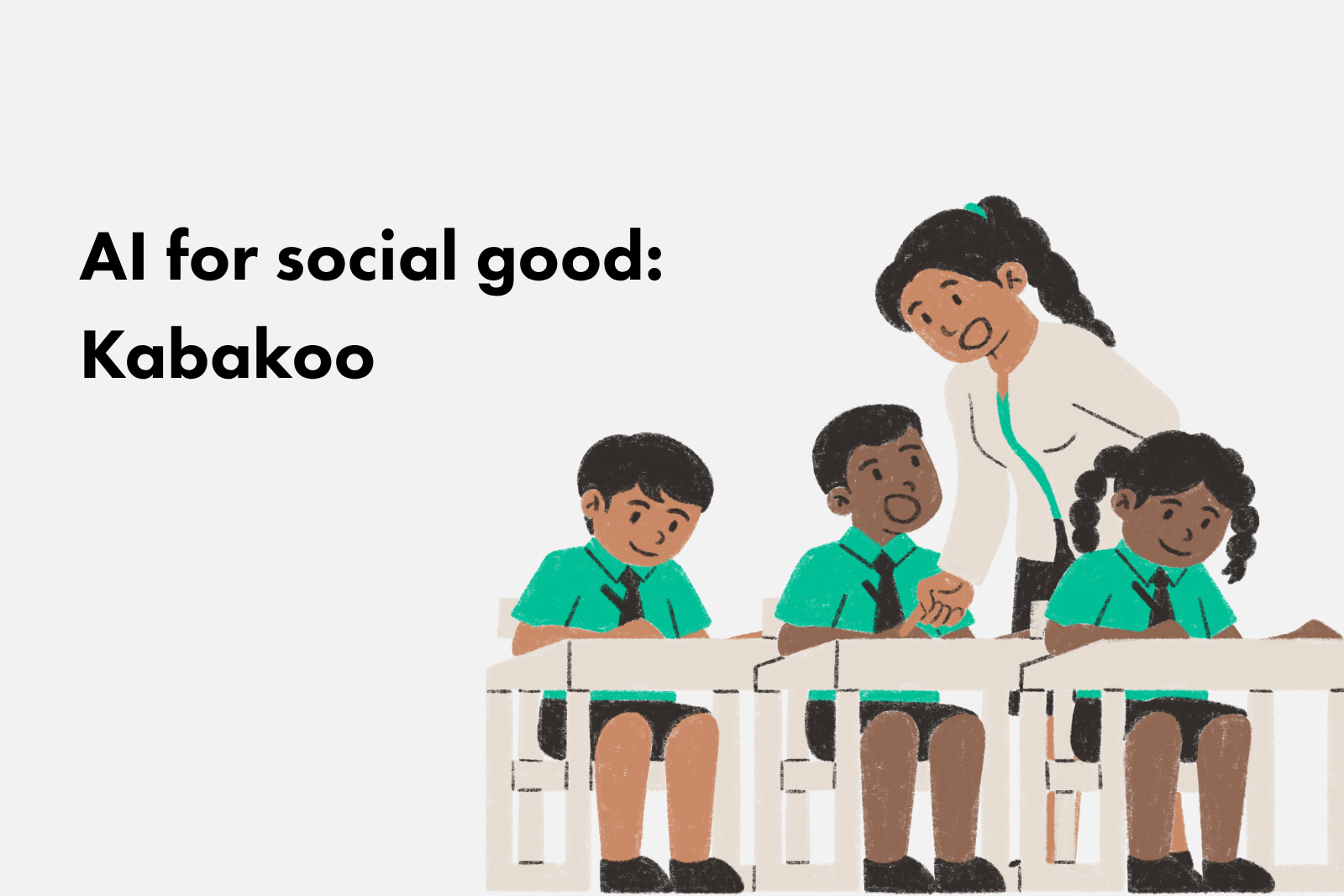
AI for Social Good: Kabakoo


This article is part of the ongoing AI for Social Good series, where we spotlight social enterprises harnessing artificial intelligence to drive meaningful change. From education to healthcare, each story in this series explores how purpose-driven organisations are navigating the opportunities and challenges of AI adoption in the real world. You can now also read a story of M-Shule, Wadhwani AI and Social Enterprise Ireland and learn how they use AI to serve their communities.
Kabakoo Academies, founded in Mali in 2018, pioneers a “Highdigenous” model of education that fuses high-tech tools with Indigenous knowledge to address youth unemployment in West Africa. Recognised by UNESCO, the African Union and the World Economic Forum, Kabakoo offers blended, project-based learning rooted in local realities while equipping learners with future-oriented skills such as digital upskilling, regenerative architecture, XR storytelling and entrepreneurship. With over 34,000 registered learners and partnerships spanning governments, international organisations and tech companies, Kabakoo empowers youth to create sustainable livelihoods, increasing average incomes by up to eight times and significantly boosting learners’ self-confidence and growth mindset. Its innovative use of AI, including a bilingual mentor in French and Bambara and XR storytelling makes education accessible and culturally relevant.
Background
Each year, over 10 million African young people enter the labour market, while the formal economy creates only 3 million jobs. In Mali, just 5% of job seekers find employment in the formal sector, leaving the majority facing unemployment, informal work, or migration. Women and non-urban youth are particularly disadvantaged due to systemic barriers. Education systems, often imported and disconnected from local contexts, exacerbate this challenge: young Africans may acquire diplomas but remain ill-prepared for productive livelihoods. At the same time, Africa is the continent most vulnerable to climate change, demanding locally relevant, sustainable solutions. Against this backdrop, Kabakoo Academies was established in 2018 by Michèle Traoré and Yanick Kemayou as a new kind of sustainability-focused EdTech. Its mission is to equip African youth with skills and mindsets to thrive within their communities, blending Indigenous knowledge with technology.
The AI solution
At the heart of Kabakoo’s model is its innovative use of artificial intelligence to provide personalised, culturally relevant mentorship. The Kabakoo AI mentor, integrated into the mobile app, offers tailored guidance and resources in both French and Bambara. This feature expands access for learners with limited formal education, making learning more intuitive and inclusive. The AI system adapts to each learner’s needs, significantly boosting engagement and helping youth explore career options and improve skills. Beyond AI, Kabakoo harnesses XR (extended reality) to merge digital storytelling with heritage preservation, enabling learners to reimagine futures in regenerative architecture, crafts and culture.
Implementation and partnership
Kabakoo operates through blended, project-based cohorts combining mobile learning, community hubs and peer collaboration. Learners tackle real-life challenges via Kabakoo Local Innovation Projects (KLIPs), applying skills in agroecology, circular economy, construction and crafts. Partnerships have been critical to implementation:
- Governmental: Collaboration with Mali’s national TVET (technical and vocational education and training) system to digitise curricula.
- International organisations, including the European Union, OIF, LuxDev, UNESCO and the African Union, have recognised and supported Kabakoo’s innovation.
- Tech sector: Collaborations with Miro, Twilio, Airtable, Notion and others to provide digital tools.
- Community mentors: Local artisans, entrepreneurs and professionals mentor learners alongside the AI system, ensuring that knowledge is both locally grounded and globally informed.
Impact and results
Kabakoo has delivered measurable and lasting outcomes:
- Economic impact: Learners report income increases ranging from three to eight times compared to pre-training levels. An independent evaluation found a 71% income increase 18 months post-training. Return on Investment analysis shows every $1 invested yields $6.30 in net economic benefit within three years.
- Mindset shift: Growth mindset increased by 23% among learners, with long-term improvements in self-confidence (47% increase) and learning habits.
- Employment and entrepreneurship: 42% of participants secured job opportunities or client projects within six months; at 18 months, this figure rose to 46%. Many graduates launched businesses in areas such as regenerative construction, circular economy and agro-processing.
- Inclusion: 22% of Kabakoo learners did not finish high school and 30% are women. The community actively promotes gender equity, with 40% of mentors being female.
- Scale and recognition: With more than 34,000 registered users, Kabakoo’s model has been recognised as a “School of the Future” by World Economic Forum and highlighted by UNESCO, the African Union and global media.
Lessons and next steps
Kabakoo demonstrates that addressing Africa’s youth employment crisis requires more than conventional schooling or short-term skilling. Key lessons include:
- Hybrid models are critical: Blending mobile access with community engagement ensures both scale and contextual relevance.
- Mindset matters as much as skills: Growth mindset, storytelling and value creation modules empower learners to become innovators, not just job seekers.
- Indigenous knowledge is a resource, not a relic: By merging ancestral practices with digital tools, Kabakoo delivers solutions that are sustainable, climate-resilient and culturally grounded.
- Evidence builds credibility: Using rigorous data collection, including randomised designs, Kabakoo strengthens its case for scaling.
Looking forward, Kabakoo plans to:
- Expand its AI mentor with improved Bambara data and multilingual capabilities.
- Scale XR storytelling and regenerative architecture training across the Sahel.
- Grow partnerships with governments and TVET systems to integrate highdigenous curricula.
- Explore circular migration pathways that prepare youth for both local innovation and regulated global opportunities.
- Build a Highdigenous Innovation Campus as a flagship hub radiating knowledge to millions through digital platforms.
References
https://www.kabakoo.africa/news/kabakoo-digital-upskilling-monthly-update-05-2025
https://azuritfoundation.org/case-studies/kabakoo/
https://www.kabakoo.africa/news/kabakoo-monthly-update-special-edition-04-2025
https://www3.weforum.org/docs/WEF_Schools_of_the_Future_Report_2019.pdf